
Why You Keep Blundering in Chess (And How to Stop)
Step-by-step strategies to catch threats early and make better decisions on the board.

Everyone wants to blunder less but no one trains for it correctly.
Most players approach blunders emotionally. They tell themselves to focus more, slow down, or be careful. That advice is vague, unmeasurable, and mostly useless. Blunders are not a personality flaw. They are a thinking process failure. Fix the process, and the blunders drop automatically.
Before talking about how to blunder less, we need to be precise about what a blunder actually is.
The Definition of a Blunder
On Chess.com, a blunder is typically categorized as a move that causes a large and immediate swing in evaluation. These are moves that lose decisive material, allow a forcing tactical sequence, or turn a winning or equal position into a clearly worse one. It is not subtle.
This is where many players misunderstand the problem.
A blunder is not the same thing as missing a tactic of your own. Missing a winning combination is disappointing, but it usually does not lose the game on the spot. Blunders usually do. Most blunders are not about what you failed to see. They are about what you allowed your opponent to do.
Even more important, most blunders are not the result of deep, engine-level calculation failures.
For intermediate players especially, a blunder is often a move you recognize as a mistake almost immediately after playing it. Your opponent hasn’t responded yet, and you already know something went wrong.
That realization usually comes from simple causes:
Leaving a piece hanging.
Missing a direct threat.
Allowing a basic tactical idea.
Overlooking a forcing reply.
This matters because it changes how you should train. If blunders were caused by deep, hidden tactics, the solution would be endless calculation drills. In reality, most blunders come from skipped questions and weak defensive awareness.
That is good news. It means blundering less is a trainable skill.
Tip 1: Flip the Board. Train Defensive Calculation
If you only solve tactics from the attacking side, you are training half a skill.
One of the most effective ways to reduce blunders is to deliberately solve tactics with the board flipped. Instead of focusing on your own strong moves, you are now looking for your opponent’s strong moves.


Solving the first position above is probably easier than solving the second position, even though they’re the exact same positions, just with the board flipped! The best way for Black to punish 1. Qe7?? (the move the puzzle started with) is 1…Rf1+ 2. Kh2 (capturing the rook allows …Qxe7) 2…Qf4+ 3. g3 Qf2#.
Flipping the board then solving tactics trains:
Faster threat recognition.
Better defensive resource awareness.
Comfort with quiet, stabilizing moves.
When you flip the board, your mindset shifts. You stop chasing brilliancies and start respecting danger. That mindset transfers directly into your games.
Tip 2: Target Hanging Piece Puzzles. Keep Them Easy
If you want maximum return on minimal effort, focus on hanging piece puzzles.
This is not glamorous training. It is effective training.
Specifically:
Choose puzzles where the main idea is a loose or undefended piece.
Keep the difficulty relatively low.
Flip the board and solve from the defending side.
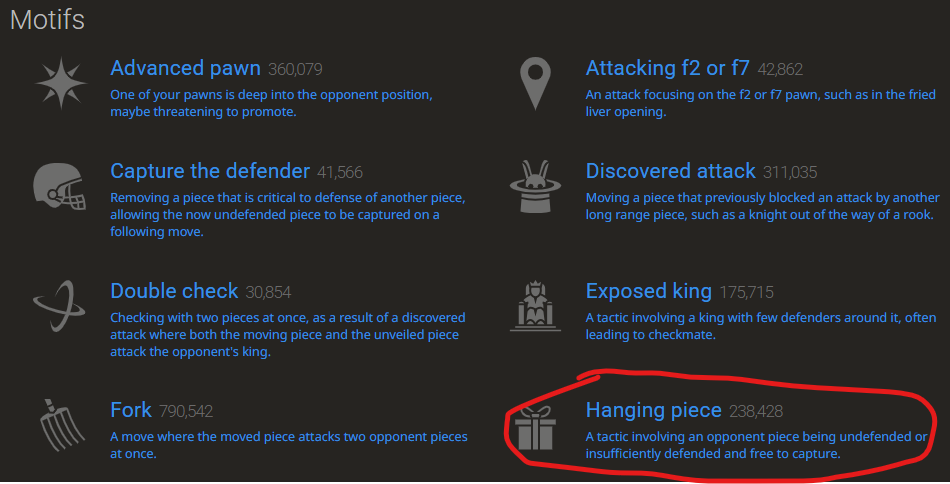
Hanging pieces are responsible for a massive percentage of real-game blunders. You do not need complex tactics to fix this. You need repetition.
Easy puzzles are ideal. The goal is not to struggle. The goal is to reinforce the habit of scanning for loose pieces and immediate threats. This is exactly the type of mistake players notice too late during games.
Tip 3: Don’t Just Solve Tactics. Reverse-Engineer Them
When you solve a tactic, do not stop after finding the winning move.
Instead:
Go back one move.
Identify the move that allowed the tactic.
Understand why that move failed.
Find a safer alternative that avoids the problem entirely.


It is Black to play in the first position above and the best move is 1…Nxh3+ 2. Kh1 Qxg4 winning material. However, if you flip the board and back up one move, now you need to figure out that 1. Kh1! is white’s only good move to avoid black’s threat of …Nxh3+.
This trains prevention, not just execution.
In real games, you are rarely punished for missing the best move. You are punished for playing moves that allow obvious replies. Reverse-engineering tactics teaches you how those disasters start.
Tip 4: Use a Cohesive Thinking Process. Then Practice It
Most players do not have a thinking process. They have instincts and hope.
A reliable process looks like this:
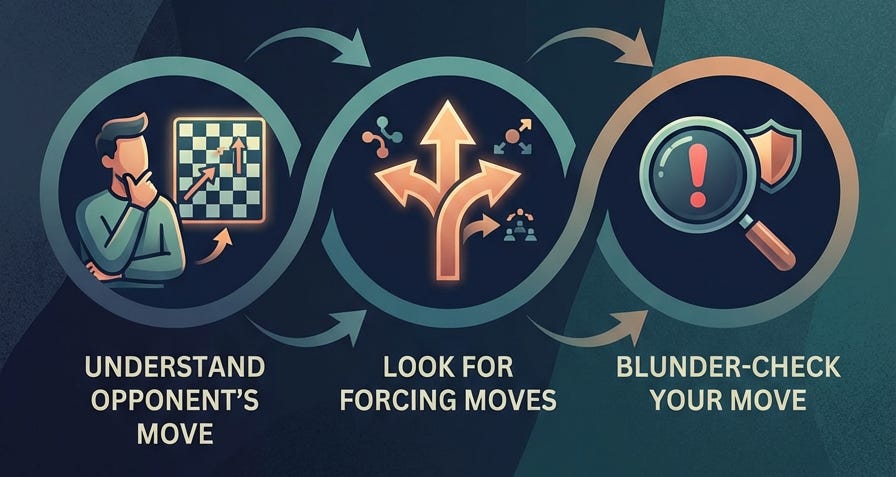
Step 1 - Understand Your Opponent’s Recent Move
Before thinking about your own ideas, ask:
What did my opponent’s move do?
Did it create a threat?
What idea is my opponent playing for?
If there is a threat, it must be addressed. Ignoring this step is how most blunders happen.
Step 2 - Look for Your Own Forcing Moves
Once you understand their idea, scan for:
Checks
Captures
Threats
Forcing moves clarify the position and sometimes let you seize the initiative instead of defending passively. Many blunders happen because players never ask if they can do something active first.
Step 3 - Blunder-Check the Move You Want to Play
Before making your move, ask:
What is my opponent’s best reply?
Do they have checks?
Captures?
Immediate threats or tactical lineups?
If the answer causes concern, discard the move. Find another one.
Strong players are not immune to bad ideas. They are better at rejecting them early. Here’s a good example from a note I wrote earlier this month:
Why Practicing This Process Works
The most common fear I hear from students when I give this advice is related to time trouble.
Players worry that using a structured thinking process will slow them down and cause them to flag. However, that fear is short-term.
A thinking process is a skill. Skills get faster with repetition.
When you practice this process outside of games, especially while solving tactics, it becomes automatic. You stop consciously running through steps. You simply notice threats, forcing moves, and danger immediately.
That is the goal.
You are not meant to think longer forever. You are meant to think better, and eventually faster. Tactical training is the safest environment to install this habit.
Build a Defensive Identity
Players who blunder less are not passive. They are disciplined.
They respect:
King safety.
Loose pieces.
Opponent counterplay.
Defense is not cowardice. It is control.
This philosophy is the foundation of my Chessable course “Survive & Thrive: How to Blunder Less and Defend Better” which was officially endorsed by GM Sam Shankland.

The course focuses on:
Defensive calculation.
Threat recognition.
Practical decision-making.
Avoiding the types of moves that start tactical disasters.
It is currently on sale for the rest of 2025, through December 31. If blundering is your biggest frustration, this course will help you.
Additional Resources Worth Studying
For alternative perspectives on defense and blunder prevention, I also recommend these other Chessable courses:
“My Opponent’s Threats: Piece Safety Training” by jdac (good for beginner players)
“Preventing Blunders in Chess” by Can Kabadayi (good for beginner/intermediate players)
These are different approaches but the same core lessons.
🎥 Practical Walkthrough. Applying This Training Method
(Paid Subscribers)
Below the paywall at the bottom of the article, I’ve included a short instructional video where I demonstrate exactly how to apply this training method in practice using the Lichess Tactics Trainer.
In the video, I show:
How to select appropriate, simple tactical positions.
How to flip the board and solve from the defensive perspective.
How to back the position up one move to identify the mistake.
How to find safer alternatives that prevent the blunder.
How to practice this efficiently without overthinking or burning time.
Watching this in real time helps bridge the gap between understanding the idea and actually using it in your own study. You see how quickly the process can be applied and what matters versus what can be ignored.
If you want to implement this method correctly and confidently, upgrading gives you a concrete model to follow rather than just abstract advice.
Final Thought
Blunders are not random. They are predictable.
Train defense.
Target hanging pieces.
Reverse-engineer mistakes.
Install a real thinking process.
Do this consistently and your rating will rise without learning a single new opening.
That is real improvement.
Be sure to watch the training walkthrough video below:
Keep reading with a 7-day free trial
Subscribe to Chess Chatter to keep reading this post and get 7 days of free access to the full post archives.